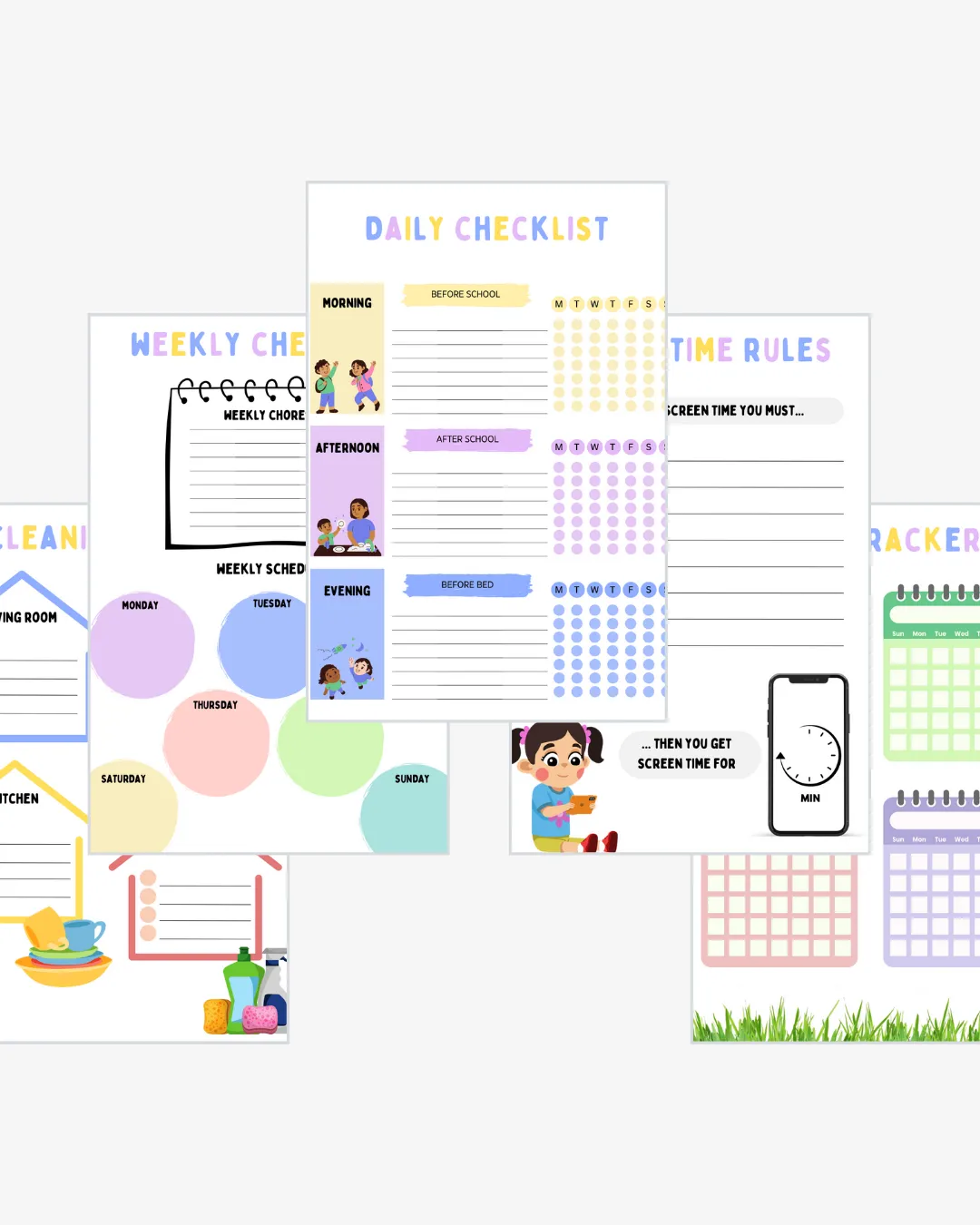
Are you exhausted from juggling countless apps, sticky notes, and scattered papers to keep your family organized? Printable planning tools offer a solution that transforms chaotic households into well-run family systems.
Unlike digital solutions that disappear into device storage, these physical organizers provide tangible, visual organization that works for every family member — from energetic toddlers to busy teenagers.
Why printable tools beat digital apps
The power of physical interaction
Research in cognitive psychology suggests that writing things down by hand improves memory retention compared to typing. When children physically check off completed tasks, they’re significantly more likely to remember and follow through with their responsibilities.
Always visible, never forgotten
Digital planners hide inside devices that get forgotten, lose battery power, or become sources of distraction. Physical planning systems stay visible on your refrigerator, bulletin board, or family command center where everyone sees them throughout the day.
Zero technology barriers
Every family member can use these systems regardless of age or tech-savviness. A five-year-old can check off chores just as easily as a busy parent, which makes the whole system genuinely inclusive.
Customizable and flexible
Print unlimited copies, write in different colors, add stickers, or modify templates to fit your family’s needs. That flexibility is impossible with most rigid digital solutions.
The 8 essential printable planning tools
1. Daily routine checklists
What they are: Time-based templates that break daily routines into morning, afternoon, and evening tasks with visual tracking circles for each day of the week.
Perfect for: Young children learning independence, families establishing consistent routines, and parents wanting to reduce daily nagging.
How to maximize their effectiveness:
- Post at your child’s eye level in their bedroom or main living area
- Use stickers or checkmarks to track completed tasks
- Include tasks like brushing teeth, getting dressed, and homework time
- Color-code time periods (yellow for morning, purple for afternoon, blue for evening)
2. Weekly planning and chore systems
What they are: Weekly organizers that combine chore tracking with schedule planning, featuring circular day layouts and dedicated spaces for weekly task lists.
Best for: Families with multiple children, households distributing chores fairly, and parents organizing both activities and responsibilities.
Essential features:
- Visual weekly chore tracking section
- Circular daily schedule layouts
- Space for family activities and appointments
- Color-coded design
3. Homework and academic trackers
What they are: Student-focused organizers with columns for assignments, due dates, and completion tracking, plus a built-in reward system.
Perfect for: Elementary and middle school students, families struggling with homework organization, and children who respond to visual progress tracking.
Must-have elements:
- Assignment and due date columns
- Visual completion tracking
- Reward section to motivate completion
- Child-friendly design
4. Multi-purpose habit trackers
What they are: Flexible monthly tracking grids that let families monitor up to four different habits simultaneously.
Ideal for: Building positive family habits, tracking wellness goals, and helping children visualize progress.
Popular habits to track:
- Daily reading time
- Water intake goals
- Physical activity
- Screen time limits
- Bedtime routine consistency
5. Screen time and digital wellness rules
What they are: Visual rule-setting templates that establish clear expectations around technology use, with “before screen time” checklists and time tracking.
Perfect for: Families managing device usage and households implementing digital wellness practices.
Key components:
- Visual “must-do” checklist before screen time
- Time tracking system with clear limits
- Child-friendly, relatable design
- Easy-to-understand rule format
6. Room-by-room cleaning charts
What they are: House-shaped cleaning organizers that break household tasks down by room — living room, bedroom, kitchen, bathroom — with visual tracking.
Best for: Teaching children household responsibility and making chores feel manageable.
Essential features:
- Room-specific task organization
- Visual tracking circles for completion
- Colorful, house-themed design
- Age-appropriate task suggestions per space
7. Activity and class schedule planners
What they are: Weekly activity organizers designed for families managing multiple schedules, sports, classes, and extracurriculars.
Perfect for: Parents juggling several schedules who want their weekly commitments visible at a glance.
Components include:
- Daily activity blocks
- Time-specific scheduling options
- Color-coded system for different family members
- Layout that’s easy to read at a glance
8. Student class schedule organizers
What they are: Academic weekly planners for students to track class schedules, with time slots and subject organization.
Essential for: Middle and high school students, and students transitioning to more complex schedules.
Key features:
- Daily time slot organization
- Subject-specific color coding
- Clean, student-friendly design
- Easy-to-read weekly layout
How to choose the right tools for your family
Consider your family’s actual pain points
Every family faces different challenges. Before selecting systems, ask yourself:
- What are our biggest organizational pain points?
- Which family members struggle most with staying organized?
- What times of day create the most chaos?
- Do we prefer simple systems or detailed tracking?
Start simple and build gradually
Don’t overwhelm your family by implementing everything at once. Choose one or two systems, give everyone time to adjust, then gradually add more.
Involve everyone in choosing
Children are significantly more likely to use planning systems they helped choose. Show them different options and let them have real input on colors, designs, and tracking methods.
Setting your system up for success
1. Create a designated planning space
Choose a central, high-traffic location where family organizers live permanently:
- A prominent wall in the kitchen near the refrigerator
- A large bulletin board in the hallway
- A designated section of your home office
- A family command center near the front door
2. Establish consistent routines
Success comes from regular use. Build in:
- Weekly family planning sessions
- Daily check-ins on progress
- Weekly review and adjustment periods
- Monthly evaluation of what’s working
3. Make it visual and engaging
Use bright colors, stickers, and attractive markers. The more visually appealing the system, the more likely your family will use it consistently.
4. Celebrate every success
Acknowledge when family members use their systems or achieve their goals. Positive reinforcement encourages continued use and builds lasting habits.
Common mistakes to avoid
Overcomplicating the system
Keep organizers simple and user-friendly. If a system becomes too complex, family members abandon it quickly and return to old habits.
Forgetting to update regularly
Planning systems only work when they’re kept current. Build regular updating into your established routines.
Not adapting to change
As your family grows and changes, your systems should evolve too. Be willing to modify or replace systems that no longer serve you.
Making organization feel like punishment
Planning should feel helpful and empowering, not like another chore. Keep the tone positive and focus on how organization makes life easier.
The long-term payoff
Families who consistently use these systems report:
- Dramatically reduced daily stress and chaos
- Significantly improved communication between family members
- Children who are more independent and responsible
- Better time management skills for everyone
- Increased family bonding through shared goals
- Higher success rates in achieving family goals
Start today
The right time to start is now. Choose one area where your family struggles most — chaotic mornings, homework battles, or chore distribution — and find a simple planning tool to address that specific challenge.
The goal isn’t perfection. It’s consistent progress. Small, regular steps toward better organization create lasting positive change for your whole family.